
Children know where the line is when it comes to hacking – but emotions can blur the boundaries
Following the Dutch Cybercrime Threat Assessment 2026 report, new HackShield data reveals how children respond to hacking and digital dilemmas.
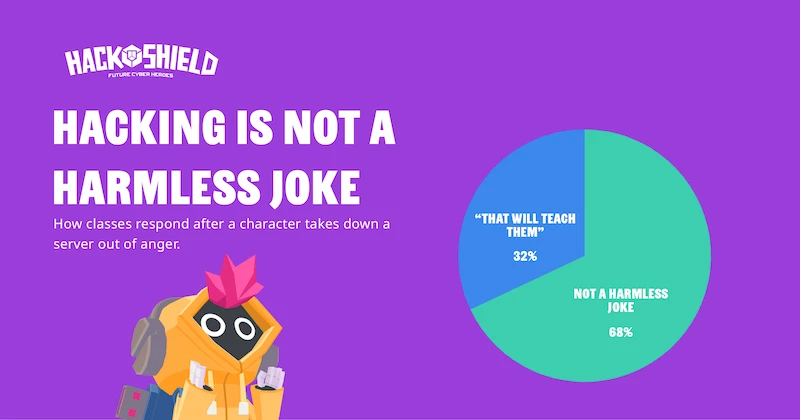
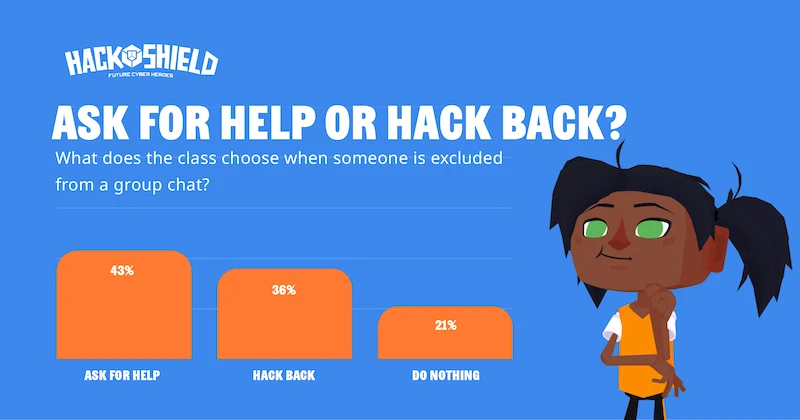
Utrecht, 4 september 2026 – New data from HackShield reveals a striking tension: 68% of classes recognise that taking down a server is not a harmless joke, yet when faced with exclusion from a group chat, 36% still choose to hack back. Asking a teacher for help, at 43%, is only seven percentage points ahead. The figures have been released one day after the publication of Cybercrimebeeld Nederland 2026 (Dutch Cybercrime Threat Assessment 2026), in which the Dutch Police and Public Prosecution Service draw attention to the involvement of young people in cybercrime. According to HackShield, the findings underline why building digital resilience needs to start at an early age.
Digital dilemmas divide the classroom
When children aged 7 to 12 discuss digital situations in class through HackShield, an interesting pattern emerges. When technical damage is involved, the boundary appears clear: 68% of classes recognise that taking down a server through hacking is not a harmless joke. But once anger, bullying or exclusion enter the equation, the picture changes. When a character in a HackShield lesson is excluded from a group chat, 43% of classes choose to ask the teacher for help. 36% choose to hack the group chat. A further 20% choose to do nothing. The data comes from HackShield’s Online Boundaries lesson. In the lesson, children aged 7 to 12 discuss a range of situations from their digital lives as a class and collectively decide which route to follow through an interactive story.
Three findings stand out:
- A harmful hack is generally not seen as a joke.
68% of classroom choices indicate that taking down a server is not a harmless joke. Even so, almost one third respond: “That will teach them.” - Asking for help only narrowly beats hacking back.
When someone is excluded from a group chat, 43% choose to ask the teacher for help. 36% choose to hack the group chat, while 20% choose to do nothing. - There is no clear consensus when someone receives a hurtful message.
41% choose to let it go, 30% choose to get even and 29% choose to respond. None of the options achieves a majority.
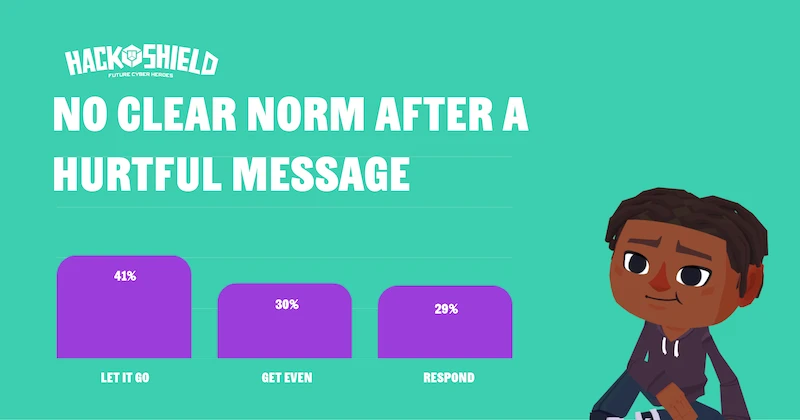
These are not individual responses, nor do the results measure what children would actually do in real life. A class discusses a situation together and then decides which route it wants to follow through the interactive story. A group may also deliberately choose a more exciting or risky route simply to find out what happens next.
It is precisely these collective choices that make the findings valuable. They reveal which situations spark discussion, where children have differing views and which digital dilemmas require further conversation and practice.
Prevention requires more than simply knowing the rules
The timing of these findings is significant. In Cybercrimebeeld Nederland 2026, presented yesterday, the Dutch Police and Public Prosecution Service describe the rise of young Western cybercriminals involved in activities including data theft and cryptocurrency theft. The research for the report has not only been conducted in the Netherlands, but in Europe. Technical knowledge and tools are becoming increasingly accessible, while within online networks, prestige and social status can play a role alongside financial gain.
HackShield believes this presents an important opportunity on the preventive side: teaching children from an early age how they can use their digital curiosity and skills in a positive way.“Children are curious and want to discover how the digital world works. That is something we should actively encourage,” says Emily Jacometti, co-founder of HackShield. “The challenge is to help children experience where the boundaries lie from an early age, and above all to show them what they can do with their skills.”
Setting boundaries while providing alternatives
According to HackShield, the classroom choices demonstrate why simply telling children that hacking is not allowed is not enough. A child may fully understand that a hack can be harmful, but when someone is excluded, hacking back can suddenly feel like a way of standing up for yourself. Children therefore also need to know what other options are available to them: not acting immediately when they are angry, saving evidence, blocking and reporting someone, or asking a parent, teacher or another trusted adult for help.
Technical curiosity also deserves a positive outlet. A vulnerability that has been discovered can be reported responsibly, while an interest in hacking can be channelled towards making other people safer. HackShield recognises talent and helps children find the right path. “Children do not learn to swim by standing on the side of the pool and being told that deep water is dangerous,” says Jacometti. “They have swimming lessons. We need to do the same online: practise situations, talk about them together and give children practical ways to respond before something goes wrong.”
About the figures
The percentages on online boundaries are based on recorded classroom choices made during HackShield’s Online Boundaries class quest. The questions and answer options vary depending on the scenario. One recorded choice may represent the collective answer of an entire class. The results therefore cannot be interpreted as percentages of individual children, personal beliefs or actual behaviour.
Classes may also deliberately choose a more challenging or risky option to see what happens next in the story. The data is intended to provide insight into the different paths classes explore together and to encourage discussion and education. It does not constitute a representative population study.
Questions about these insights?
Please contact Emily Jacometti at [email protected]